Anh Vo: Tỳ Bà Hành…But Alas There Was No Music
Anh Vo
Vũ Thuỳ Linh
Phạm Đình Hoằng
October 3, 2026 at 4:00 PM
Emily Harvey Foundation
537 Broadway #2
New York, NY 10012
FourOneOne presents Anh Vo: Tỳ Bà Hành…But Alas There Was No Music, a rare opportunity to experience this quintessential piece from the endangered northern Vietnamese chamber music form ca trù, which has not been performed publicly in its entirety since 1945.
Tỳ Bà Hành is the latest installment in performance artist Anh Vo’s ongoing dialogue with ca trù, which traces its origins to royal courts and rituals of the 9th century. Banned in the 20th century by the Communist government because of its perceived associations with elitist antiquity, prostitution and opium culture, very few knowledgeable ca trù practitioners now exist. Despite its inclusion on UNESCO’s Intangible Cultural Heritage list in 2009, teachers and apprentices still must navigate generational gaps in oral transmission and adapt new ways of reconstructing this extraordinary and fragile tradition. Yet ca trù persists, austere and trance-like, built on intricate poetic meters and the striking interplay of female voice, lute and drum.
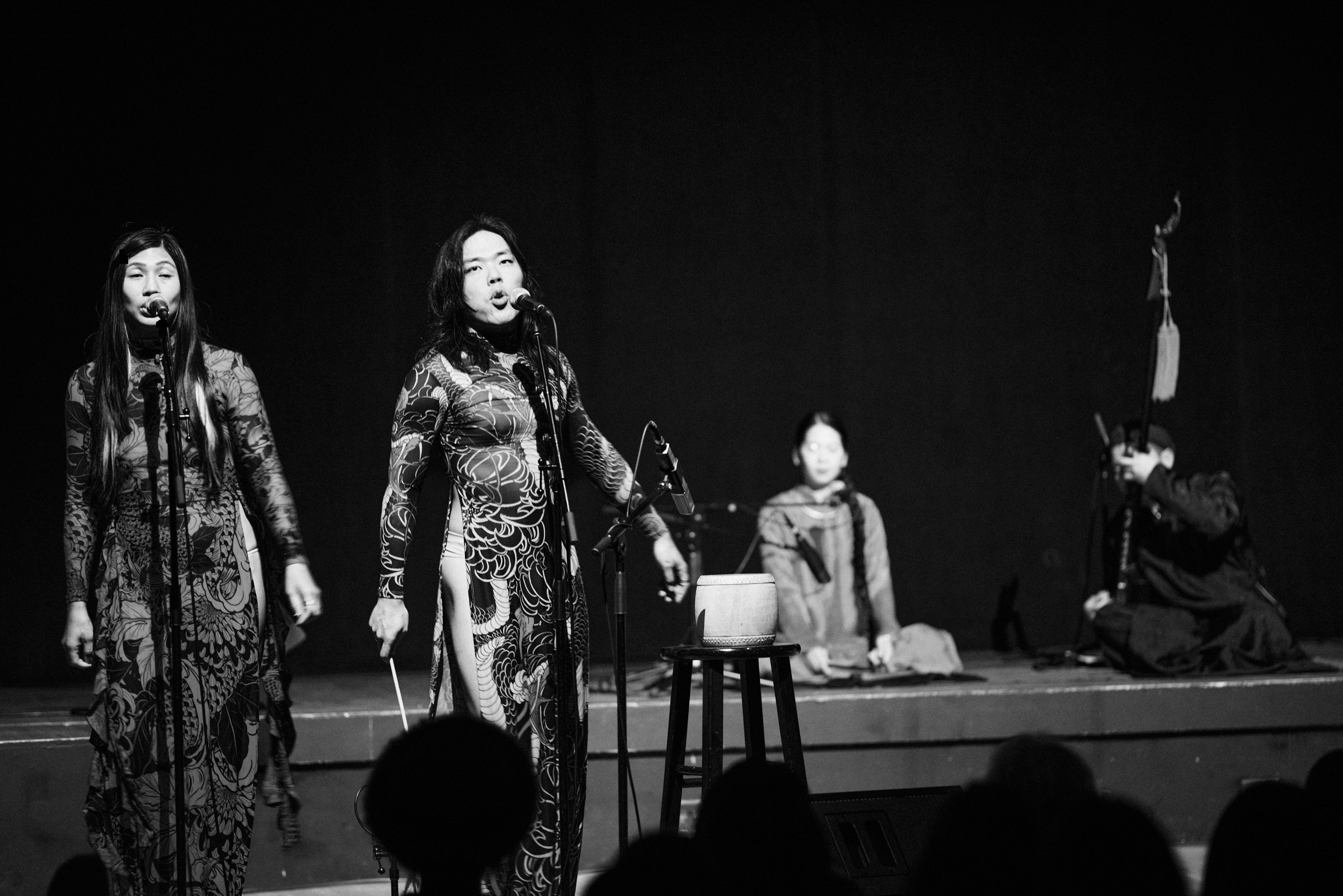
Vo began to study ca trù in 2024. Together with their teachers, singer Vũ Thuỳ Linh, who also beats the poetry’s intricate metric structures on a section of bamboo (phách), and đàn đáy (3-string long necked lute) player Phạm Đình Hoằng, Vo will give an unabridged performance of Tỳ Bà Hành (琵琶行 Pipa Song) by the Chinese poet Bai Juyi. A Tang dynasty poem that probes the parallel feelings of exile and loss of status experienced by a demoted government official and an aging female musician, the entire poem takes roughly 50 minutes to perform. But even amongst the most educated scholars and practitioners of ca trù, few have the knowledge to attempt the piece in its entirety.
Vo’s part in the performance will be the “spectator” (in the ca trù tradition, often a scholar or connoisseur of the art) who strikes a trống chầu (praise drum) in praise (or disapproval) of the singer's performance. Vo’s connection to the work is personal; their great-grandmother was a ca trù singer on Khâm Thiên street in Hanoi, once notorious for its singing houses, opium dens, and intimate entanglements between art and sex work. Vo’s great-grandmother was eventually bought out of the singing house by their great-grandfather to be his second wife—a fact that echoes the life of the courtesan musician in Bai Juyi’s poem, who is married to a merchant in her later years.
Even though Vo had never heard the music in person, when they did finally encounter ca trù, it was not as a neutral “heritage form.” They understood that the music’s virtuosity and refinement were historically inseparable from the lives of the women whose artistry unfolded within colonial economies of pleasure and precarity.
Based in Brooklyn and Hanoi, Anh Vo is a Vietnamese choreographer and writer working in the expanded field of performance. Their practice mobilizes the naked body in its variations to make explicit the entanglement of power and ghostly forces that cut across flesh. Their work emerges from the unlikely lineage convergences between Downtown New York experimental performance, Hanoi performance art, and Vietnamese folk ritual practices. Vo is indebted to Miguel Gutierrez's unapologetic queerness and amorphous excess, Moriah Evan's speculative commitment to the depth of interiority, Julie Tolentino's durational poetics of intimacy, Tehching Hsieh’s existential sense of time, and Ngoc Dai’s guttural sonic landscape of postwar Vietnam.
In 2014, Vũ Thuỳ Linh and Phạm Đình Hoằng founded the A Dao Phu Thi Ensemble, dedicated to preserving and presenting ca trù's most original and refined qualities. The group’s members studied directly with the late master artists Nguyen Phú Ðe and Nguyen Thi Chuc, from whom the ensemble takes its name (Phu and Thi). Beginning their training in 2006, the musicians learned through oral transmission and honed their skills through years of performing alongside their teachers. The ensemble has earned multiple gold and silver medals at regional and national ca trù festivals and continues to expand its repertoire through archival research and restoration. In 2017, they collaborated with scholar Bui Trong Hien to reconstruct the ceremonial hat cua dinh repertoire, reaffirming ca trù as a living, evolving heritage.
FourOneOne's programs are made possible in part by the New York State Council on the Arts with the support of the Office of the Governor and the New York State Legislature.