ABOUT
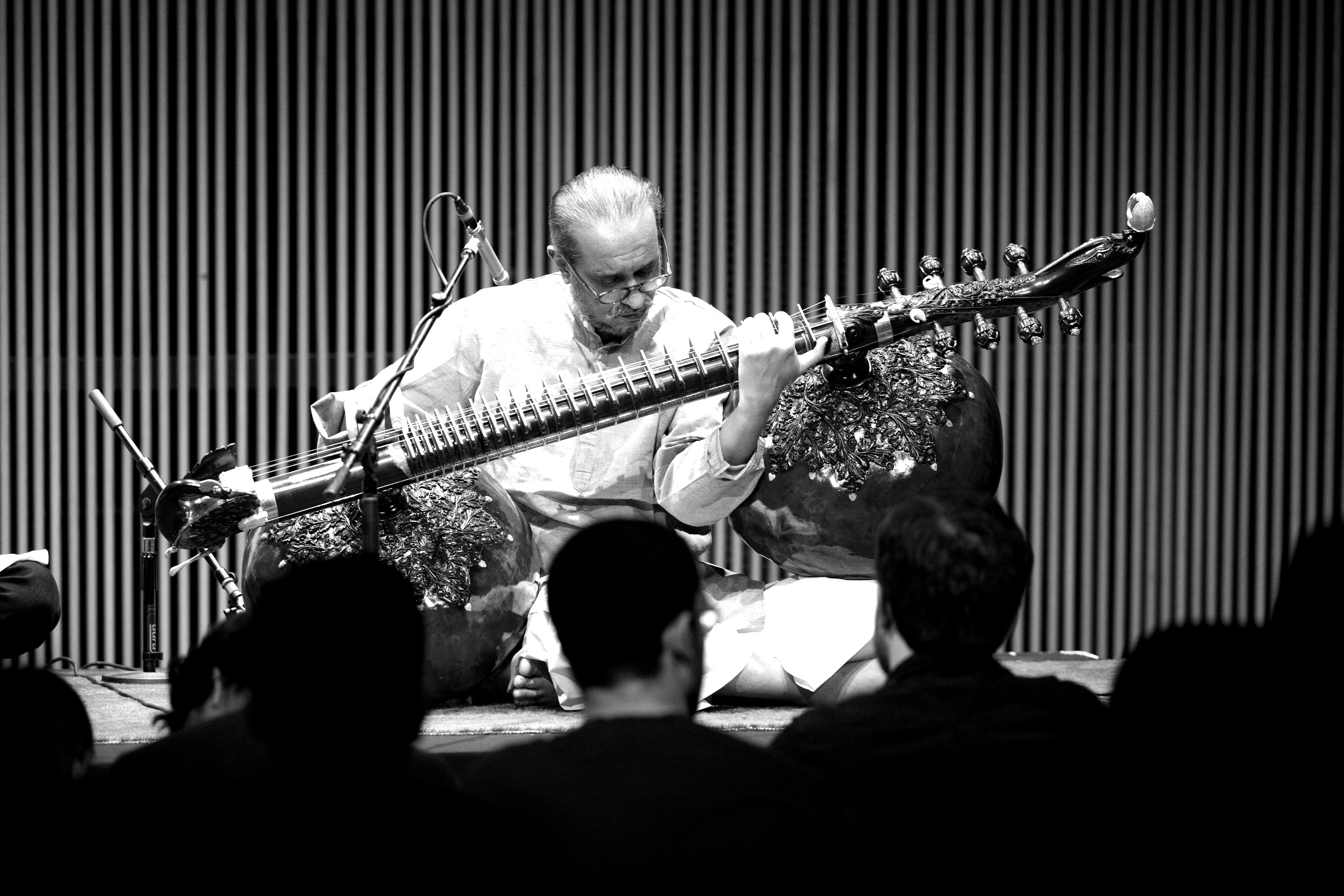
Ustad Bahauddin Dagar, renowned rudra veena player and 20th generation practitioner of the Dagarvani tradition of Dhrupad, the oldest living form of Indian classical music, returns to New York in May and June, 2026. Part of his ongoing, multi-year collaboration with FourOneOne, this series of programs revives and reimagines the dialogue between this profound tradition and Western audiences, performers, scholars and students, first initiated in the 1960s by the Senior Dagar Brothers, and continued by Ustad Dagar's father, Zia Mohiuddin Dagar, and uncle, Zia Fariduddin Dagar, and others from the 1970s through the present day.
Dhrupad communicates principally through the emotions expressed in its characteristic structures: long, achingly subtle melodic unfoldings that eventually yield to ecstatic, rhythmically explosive passages. A performance is at once spontaneous and deeply grounded in the framework of the raga (“that which colors the mind”). Ideally, the performer becomes a channel, allowing both themselves and the audience to inhabit states analogous to the “pure bliss of the realization of reality.” This is, above all, a music of feeling, one that has engaged listeners from all over the world at the deepest possible levels. In New York, more than a half century ago, the Dagars caught the ears of jazz trailblazer Don Cherry who, like many others, sought out Zia Mohiuddin Dagar in Mumbai for informal training.
This residency fosters new convergences between these communities and histories through a major, evening-length concert at the DiMenna Center for Classical Music on May 29, and a series of intimate performance/conversations in May and June with four artists from New York City’s rich web of performance histories: guitarist Brandon Ross of Black Rock power trio Harriet Tubman, also a longtime collaborator of Henry Threadgill and Cassandra Wilson; vocalist/electronicist Shara Lunon of improv cooperative History Dog and the incendiary punk band Blasé; Vietnamese decolonialist ritual performance artist Anh Voh; and Aakash Mittal, a saxophonist and composer whose research has spanned both South Asian classical forms and the multimodal concepts of the revolutionary drummer, martial artist, herbalist and heart “sonocytologist” Milford Graves.
Dhrupad has been practiced continuously by members of the Dagar family since the 15th century. Strictly a vocal music for most of that history, the rudra veena, one of the oldest string instruments in Hindustani music, was used purely for private study and accompaniment. It was only in the twentieth century that Ustad Zia Mohiuddin Dagar began to perform publicly with the rudra veena as a solo instrument, and, against his own father’s wishes, made physical modifications to the instrument to make it suitable for public performance.
Born in Mumbai in 1970, Ustad Bahauddin Dagar carries forward this deeply rooted and experimental performance tradition. He began studying sitar at age seven with his mother, Smt. Pramila Dagar, and later became a student of his father, Ustad Zia Mohiuddin Dagar, and his father’s brother, renowned singer Zia Faridudin Dagar. Since his formal debut as a musician in 1990, Ustad Dagar has become acclaimed for his highly responsive playing style, his expansive, prayerful sound, pursuit of dhrupad’s evolution, and commitment to Dagarvani’s engagement with European and American musicians, composers and audiences.