ABOUT
This Spring, FourOneOne collaborates with producer, bassist, and writer-thinker Melvin Gibbs on a series of events celebrating his singular life in music thus far—a path that has always been both absolutely of the moment and intimately linked to the ancestral knowledge that shapes our sense of music, community and history—and his highly anticipated new book, How Black Music Took Over The World.
A book that could only have come out of Gibbs’ uniquely faceted journey—through jazz fusion, free funk, no wave, alternative rock and into genre-defying forms—How Black Music… anchors this residency around the idea that the musical forms of the American present are inseparable from the experiential life worlds of the Black diaspora and their embodied performance traditions.
From April through July, at venues around the city, Gibbs and a constellation of collaborators and friends—including Vijay Iyer, Immanuel Wilkins, Ben LaMar Gay, Kokayi, Tcheser Holmes, Chris Williams, Luke Stewart, Warren "Trae" Crudup III, Paul Wilson Bae, James Francies, choreographer Leslie Parker, and theoretical physicist Stephon Alexander—assemble to explore and respond to the book’s major themes through listening, conversation and performance.
How Black Music Took Over the World (Basic Books, April 2026) is Gibbs’ first book. An intensely original hybrid of musicology, history, and memoir, How Black Music… is a sweeping, rigorous account of the musical inheritance of Africa. Gibbs’ writing is an informal, first-person approach to the scientific, musical, religious and social structures central to the development of Black music across the world. He borrows concepts from acoustics to explain how different cultures derive melody from the physics of sound; from geometry to elucidate the Yoruban cellular rhythmic structures that give funk and dance music “their body-moving power”; and from evolutionary biology to account for Black musicians’ drive to solve problems by making do with “whatever is at hand” culturally, technologically, and kinesthetically. Through the lens of Melvin’s lifetime of experience across genres, How Black Music… wrestles the analysis of Black music “out of the straitjacket” of Western-centric musicology to, in his words, “analyze the music on its own terms, using tools I’ve uncovered and methods I’ve either discovered or had passed on to me.”
One of the finest living bassists in creative music, Gibbs is just as often a producer, serving as conceptual and sonic architect of projects that use electronics to meld ancestral and forward-looking forms. His personal history is a journey through the major musical movements of New York City, from free jazz, Harmolodics and free funk alongside Sonny Sharrock, Ornette Coleman and Ronald Shannon Jackson to the No Wave of Defunkt and James White and the Blacks. He was a founding member of the Black Rock Coalition with Vernon Reid, a member of Rollins Band, and has collaborated with Pete Cosey, Arto Lindsay, theoretical physicist Stephon Alexander, artist/filmmakers Matthew Barney and Arthur Jafa, Kassa Overall and Georgia Anne Muldrow.
A lifelong learner, his research and collaborations have found him in community with Carnaval bands in Bahia, blues elders in the Mississippi Delta, and at Alice Coltrane’s ashram.
Harriet Tubman, his longstanding, cooperative power trio with guitarist Brandon Ross and drummer J.T. Lewis, manifests collective research and experience in raucous, liberatory music.
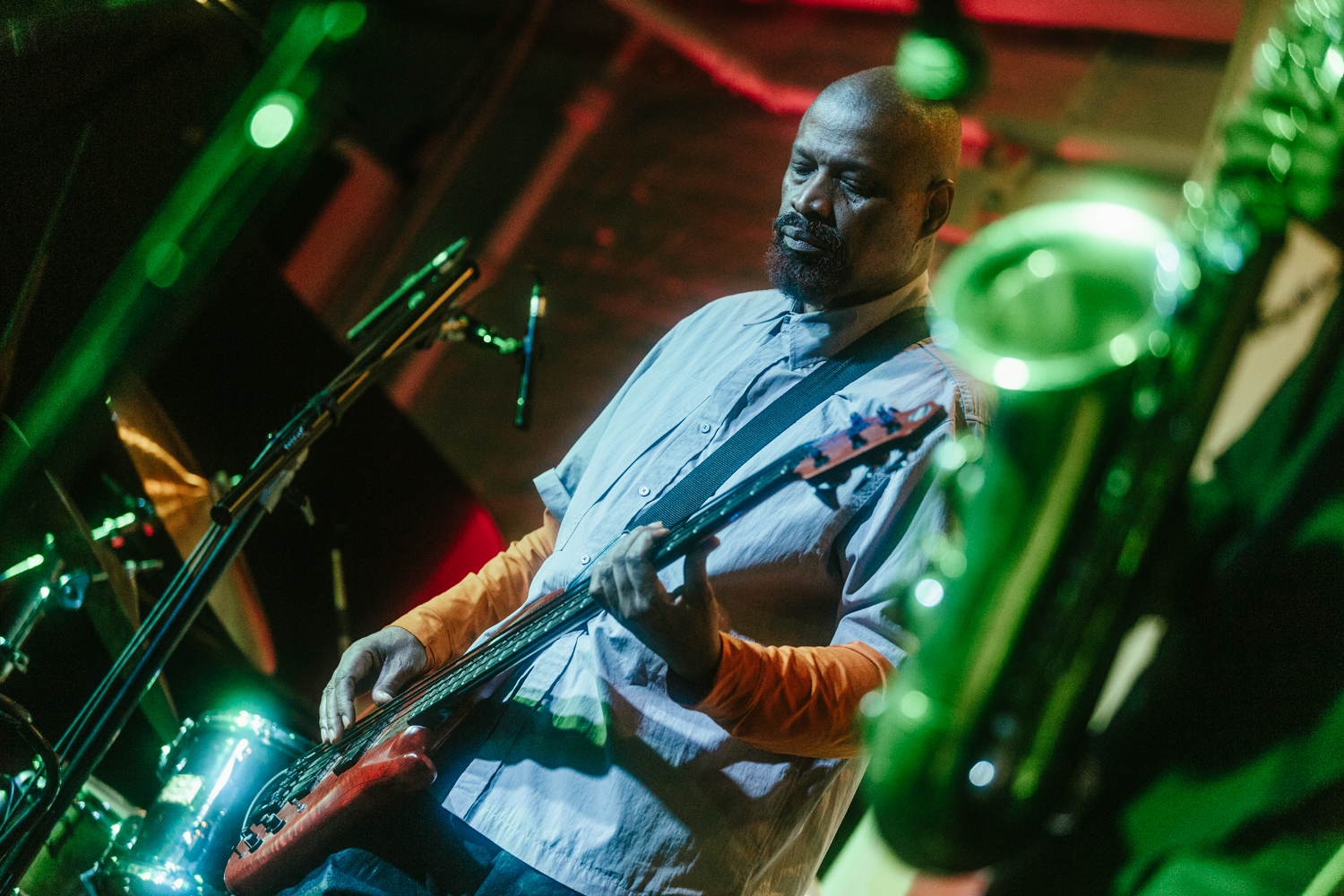
Photo Credit: Silvia Saponaro.